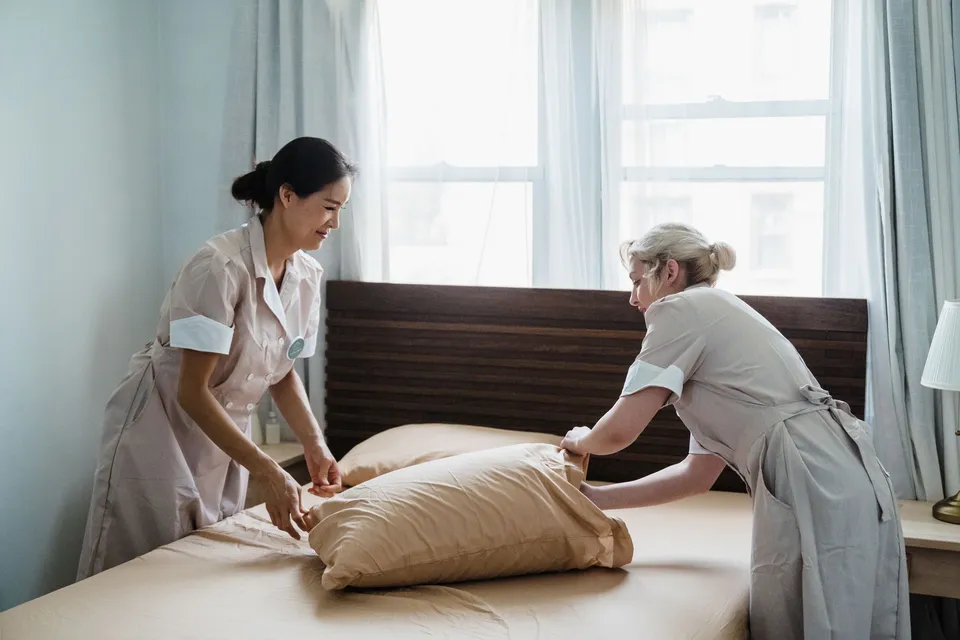
A North Shore resort that says it cross-trains workers is not making a vague culture statement. It is describing a staffing system that can only work if the property knows which tasks are interchangeable, which tasks are not, and who has authority to finish the handoff. At a small property, that distinction can decide whether guest service feels smooth or scrambled. Golden Eagle Lodge’s published employment page is a good example: the family-operated site is 27 miles outside Grand Marais, says it typically has only six to eight employees, and lists duties that range from lawn mowing and boat cleaning to wood handling, campground maintenance, trail work and housekeeping. It also says employees need their own vehicle and that there is no public transportation on the Gunflint Trail. Those details matter because they show why “helping wherever needed” is not a casual slogan in remote northern Minnesota; it is the operating model.
Cross-training works only when the work is specific
A resort job description should not stop at a department name. “Guest services,” “grounds” or “recreation” can each hide very different duties depending on the property. In the research report, the work areas are separated into reservations/front desk, housekeeping/laundry, kitchen/dining, maintenance/grounds/marina/recreation, and administration/management. That is the right level of detail because the handoff between departments is where service either recovers or breaks down. A front desk worker can note a guest request in the booking record, but someone still has to fix the unready room, explain the delay and relay the information to the right department. The report also notes that Golden Eagle explicitly tailors duties to employee strengths and cross-trains staff, which is useful precisely because the property is small and the team is small.
For employers, the practical lesson is simple: cross-training should mean “can perform a second task after training,” not “can be dropped into any department at any moment.” A worker hired for outdoor upkeep does not automatically have the authority or skill to handle food safety, operate equipment, or supervise another team’s work. Likewise, a housekeeping employee may be able to learn laundry or supply runs without being ready to manage guest complaints at the desk. When job ads blur those lines, they create avoidable friction during peak turnover days and shoulder-season coverage gaps.
Small properties and full-service resorts need different staffing logic
Northern Minnesota has many resort types, and their staffing logic is not the same. A cabin property may rely on fewer workers who move between guest contact and physical upkeep. A campground needs site care and shared-facility attention. A marina adds watercraft and dock-related work. A full-service property can separate reservations, front desk, room attendants, laundry, restaurant service, cooking, maintenance and recreation. The research report’s comparison between Golden Eagle Lodge and Bluefin Bay shows how different those models can be: Golden Eagle emphasizes a tiny team and tailored work, while Bluefin Bay advertises full- and part-time work, onsite housing, some bonus opportunities, specialized training and internal advancement. Neither model is “better” in the abstract; they simply solve the staffing problem differently.
That distinction matters for supervisors writing openings. If the property is small, the ad should say what is expected on a normal day, not just what departments exist in theory. If the property is larger, the ad should explain where the handoff stops and starts: who takes the reservation issue, who fixes the room, who handles an escalated guest complaint and who can approve a schedule change. The most useful ads are concrete about routine duties and clear about occasional cross-coverage. That is especially important in remote work settings where recruiting reach is shaped by travel distance, commute time and whether workers can actually get to a shift.
Northern Minnesota geography changes the job, not just the commute
This is where the region’s labor market becomes part of the work itself. DEED’s county profiles show that Crow Wing County has a much larger resident base than Cook County, and the same report notes very different commuting patterns: most Crow Wing resident workers travel by car, truck or van and have an average commute of 23.1 minutes, while Cook County has a smaller local base, more work-from-home workers overall, and still a substantial share of car travel. Those are county-level numbers, not resort-specific staffing counts, but they help explain why a Brainerd-area employer and a remote Gunflint Trail employer cannot use the same hiring assumptions. A job close to a larger local labor market can lean more on daily commuters; a remote North Shore property may need housing, transportation planning and stronger retention because the geography itself narrows the pool.
The report also notes that public transportation is not available on the Gunflint Trail and that Golden Eagle’s staff housing is available at about $5 per day, or roughly $150 per month, with utilities and internet included. That is a concrete employer arrangement, not a regional standard. For workers, those facts change the real cost of accepting a job. For employers, they change the way a schedule works: if a worker lives onsite but still needs personal transportation, the property has to think about errands, access to services and off-hours coverage differently than a hotel in a town center would.
Training is not the same as authorization
One of the most useful distinctions in resort work is between being trained and being allowed to do a task independently. The Minnesota Department of Health says most food establishments must employ a Certified Food Protection Manager, and that role includes hazard identification, food-safety procedures, employee training, corrective action and inspections. That does not mean every kitchen worker needs the credential. It means the business must separate support tasks from the person who carries formal food-safety responsibility. The same logic applies elsewhere: housekeeping orientation is not the same as knowing chemical hazards and ergonomics; a front desk system tutorial is not the same as handling payment records; and cross-training is not a substitute for property-specific authority.
This is also why “seasonal” should not be treated as a shortcut for lower standards. The report notes that Minnesota overtime rules, sick and safe time, paid leave and wage notices all have their own terms, and that a seasonal label does not erase the need to treat hours, allowances and pay correctly. For a resort supervisor, the takeaway is not legal jargon; it is operational discipline. If a role includes training time, setup, closing work or required meetings, those tasks need to be planned, scheduled and paid according to the rules that apply.
A better job description starts with one clear question
Before publishing a resort opening, ask: what exact handoff does this job own? If the answer is “guest requests move from front desk to housekeeping to maintenance,” say that. If the answer is “this role covers trail work in summer and Nordic support in winter,” say that. If the answer is “this employee may also help with housekeeping when the team is short,” say that too. Northern Minnesota applicants can handle hard work and variety; what they cannot usefully handle is guesswork about what the day will actually require.
For employers in the North Shore and Gunflint Trail area, the best next step is to review one current posting and make the duties, seasons, worksite and training boundaries visible before the interview. That small change can save a lot of confusion later.